Key takeaways
- Every piece of mortgage marketing — website, ad, social bio, email signature — is advertising and carries the same core disclosures.
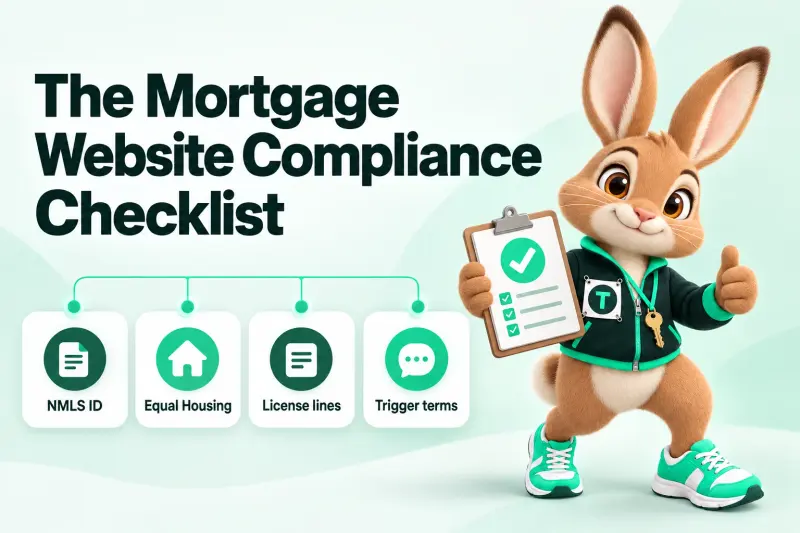
- Show your individual NMLS ID, your company's name and NMLS ID, and accurate licensed states.
- Use Equal Housing Opportunity (or your company's Equal Housing Lender wording) on every page.
- Trigger terms (down payment %, number of payments, payment or finance charge amounts) require full Regulation Z disclosures; the simplest fix is to avoid them.
- Consent before calls and texts, honest reviews, and a privacy notice at every form round out the basics. This is education, not legal advice.
Before you read: I’m an editorial persona for our compliance desk, not a lawyer. This guide explains public rules in plain English so you can have a better conversation with your compliance team. It is not legal advice, and your company’s policies may be stricter.
Mortgage marketing compliance has a reputation for being impossibly detailed. The core of it, though, is a short list that applies to every website, ad, social profile and email you send. Get that list right everywhere, and most of the remaining questions become “check with compliance” rather than “start over”.
What counts as mortgage advertising?
Almost everything you publish to win business. Regulation Z defines an advertisement broadly as a commercial message that promotes consumer credit, and in practice compliance teams treat all of these as advertising:
- Your website and every page on it, including old blog posts
- Social media profiles and posts used for business
- Email signatures and newsletters
- Flyers, open-house sheets and co-branded materials with agents
- Paid ads, landing pages and funnels
- Text messages and automated replies
If it promotes your lending, assume the rules apply.
The identity disclosures: who you are and who licenses you
Your NMLS ID
Under the SAFE Act framework (implemented in Regulation H, 12 CFR Part 1008), states require loan originators to be licensed or registered through NMLS and to use their unique identifier. State rules commonly require that identifier on solicitations and advertising — websites, business cards, social profiles. Your individual NMLS ID stays with you for your whole career.
Do: show “NMLS ID ######” next to your name in the site footer, on your bio page, on your contact page and in social bios. Link it to NMLS Consumer Access.
Your company’s name and NMLS ID
Borrowers need to know which licensed company you originate through. Most lenders dictate the exact format (“Jordan Example, NMLS ID ###### | Example Lending Co., NMLS ID ######”).
Your licensed states
List only states where you’re actively licensed — and keep it current. Advertising to borrowers in a state where you aren’t licensed is one of the easiest problems to create by accident, especially after a license lapses or a company change.
The fair lending disclosures
Equal Housing Opportunity
Fair housing advertising guidance (see 24 CFR Part 110 and HUD’s related guidance) expects the equal housing statement or logo in housing-related advertising. Lenders typically require “Equal Housing Opportunity” or “Equal Housing Lender” — and the official logo or the text — on every page and ad. Use the official asset; never redraw it.
Language and imagery
Fair lending laws (the Fair Housing Act and the Equal Credit Opportunity Act / Regulation B) prohibit discouraging applicants on a prohibited basis. In marketing, that means avoiding phrases that signal a preference (“perfect for young families”, “ideal for empty nesters”) and avoiding imagery that consistently shows only one kind of borrower.
The big one: trigger terms
Regulation Z §1026.24(d) says that if a closed-end credit ad states certain terms, it must also state other terms. The trigger terms are:
| If your ad states… | Example | You must also disclose… |
|---|---|---|
| Amount or percentage of any down payment | “Just 3% down” | Down payment, terms of repayment, APR |
| Number of payments or period of repayment | “30-year loan” | Down payment, terms of repayment, APR |
| Amount of any payment | “$1,850 a month” | Down payment, terms of repayment, APR |
| Amount of any finance charge | “Closing costs under $3,000” | Down payment, terms of repayment, APR |
Separately, §1026.24(c) says any rate of finance charge must be stated as an annual percentage rate, and §1026.24(i) lists misleading terms (for example calling a rate “fixed” without saying for how long, in some contexts).
The simplest compliant habit: talk about programs, process and people rather than numbers. “FHA loans can help first-time buyers with smaller down payments — let’s look at your options” is helpful and usually free of trigger terms. If you want to advertise specific terms, your compliance team writes the disclosures with you.
Misrepresentations and superlatives
Regulation N (12 CFR Part 1014) prohibits material misrepresentations in mortgage advertising — about rates, fees, government affiliation, the type of product and more. In practice, compliance teams are wary of:
- “Lowest rates” or “best rates in town”
- “Guaranteed approval” or “everyone qualifies”
- “No closing costs” (often inaccurate in some form)
- Anything implying government endorsement (“government-approved lender”)
Describing who insures or guarantees a loan program (for example that FHA loans are insured by the Federal Housing Administration) is factual; implying the government endorses you is not.
Consent, privacy and reviews
Calls and texts
The Telephone Consumer Protection Act and FCC rules restrict automated calls and texts without the right consent. Your forms should say clearly how you’ll contact people (calls, texts, automated), that consent isn’t a condition of purchase, and how to opt out. For business texting from ordinary numbers, carriers require A2P 10DLC registration.
Privacy notice
State privacy laws such as California’s CCPA/CPRA require notice at the point of collection. Put a privacy policy link beside every form, not just in the footer.
Reviews and testimonials
The FTC’s rule on consumer reviews and testimonials (16 CFR Part 465) bans fake reviews (including AI-written ones), buying reviews, and certain suppression of negative reviews. Only show real reviews, with the source and date. If you’re new and have none, show your process instead.
How we prioritize the checklist
Not every item carries the same risk. In our checklist, identity disclosures, Equal Housing, trigger terms and contact consent carry the highest weight because they’re both common and serious when wrong.
Where the checklist items sit
Show data table
| Group | Items |
|---|---|
| Identity & licensing | 5 items |
| Fair lending | 2 items |
| Advertising & trigger terms | 5 items |
| Privacy & consent | 3 items |
| Trust & accessibility | 3 items |
Who checks what?
Who owns which part
You
Responsible for your marketing
- Know your licenses and states
- Approve every page and post
- Easy to miss old content
Your company
Sets the rules and approves
- Required wording and logos
- Recordkeeping
- Review queues take time
Your website provider
Builds to the rules
- Places disclosures sitewide
- Runs a checklist before launch
- Cannot give legal advice
RESPA and co-marketing
RESPA Section 8 (Regulation X) restricts giving or receiving anything of value for referrals of settlement services. It’s why co-marketing with real estate agents (shared flyers, co-branded landing pages, shared ad spend) needs a careful, documented split of costs. If you plan co-marketing pages on your site, route them through your compliance team first.
How do the rules apply to everyday marketing?
Here are five situations loan officers ask about most, and how compliance teams typically think about them. Always confirm with your own team.
An open-house flyer with an agent
A co-branded flyer is advertising for both of you. It needs your NMLS ID and company details, Equal Housing, and no trigger terms without full disclosures. If it shows a sample payment, it needs the Regulation Z disclosures — and cost sharing with the agent should be reviewed for RESPA Section 8.
A short video on social media
Treat the video and its caption as an ad. Your NMLS ID belongs in your profile bio, and anything you say on camera about down payments or payments counts the same as written text. Educational videos (“what closing costs pay for”) are usually the safer format.
A “today’s rates” post
This is where trigger-term and APR rules bite hardest, and rates go stale within a day. Many compliance teams discourage it entirely. If yours allows it, use their approved template with the date, APR and assumptions.
A testimonial from a happy client
Real, unedited in meaning, with permission, and shown with its source and date. Never write one for a client to “approve”, and never offer anything in exchange for a positive review.
An old blog post from three years ago
Old posts are the most common place stale rate or payment examples hide. Search your site for ”%” and ”$” in rate or payment contexts and update or remove what you find.
How do you fix an existing site in an afternoon?
- Footer first. Add or correct your NMLS ID, company name and company NMLS ID, licensed states and Equal Housing. Because the footer appears on every page, this one change fixes most of the site.
- Search for numbers. Look for down payment percentages, payment amounts and rates. Remove them, or add full disclosures with your compliance team.
- Check every form. Consent language for calls and texts, a privacy link, and no sensitive fields.
- Review testimonials. Remove anything you can’t source and date.
- Send it for approval and keep the approval email.
If your platform makes these edits hard, that’s a sign the site is costing you more than it should.
A one-page compliance routine
- Every page: NMLS IDs, company name, licensed states, Equal Housing, privacy link
- Every form: consent language, privacy link, no SSNs or account numbers
- Every ad and post: NMLS ID in the profile, no trigger terms without disclosures
- Every quarter: search your site and PDFs for ”%” and ”$” in rate or payment contexts; delete or update anything stale
- Every change (license, company, program): update the footer block the same day and keep the approval email
Compliance done this way isn’t a quarterly panic. It’s a footer that’s right on every page and a habit of asking before you publish numbers.

Written by
Rosa Quintero, Compliance & AI Editor
Rosa writes about mortgage advertising rules, consent, and how AI receptionists and chat should behave for loan officers.
Editorial persona — GetsMortgageNow compliance desk · Not a lawyer; cites primary sources (CFPB, FCC, HUD)
Sources
- CFPB — Regulation Z §1026.24 (advertising)
- CFPB — Regulation N (Mortgage Acts and Practices — Advertising), 12 CFR Part 1014
- CFPB — Regulation H (SAFE Act), 12 CFR Part 1008
- eCFR — 24 CFR Part 110 (Fair Housing poster / equal housing)
- eCFR — 16 CFR Part 465 (consumer reviews and testimonials)
- CFPB — RESPA (Regulation X)
- FCC — Telemarketing and robocalls (TCPA)
Educational content, not legal, compliance or financial advice. GetsMortgageNow is not a lender.
 Your first loan officer website: a 30-day plan
 Switching mortgage companies: the website checklist
 AI chat on social and SMS for loan officers