Key takeaways
- Your first site has one job: turn "who is this?" into a conversation — photo, bio, NMLS ID, programs, and two next steps.
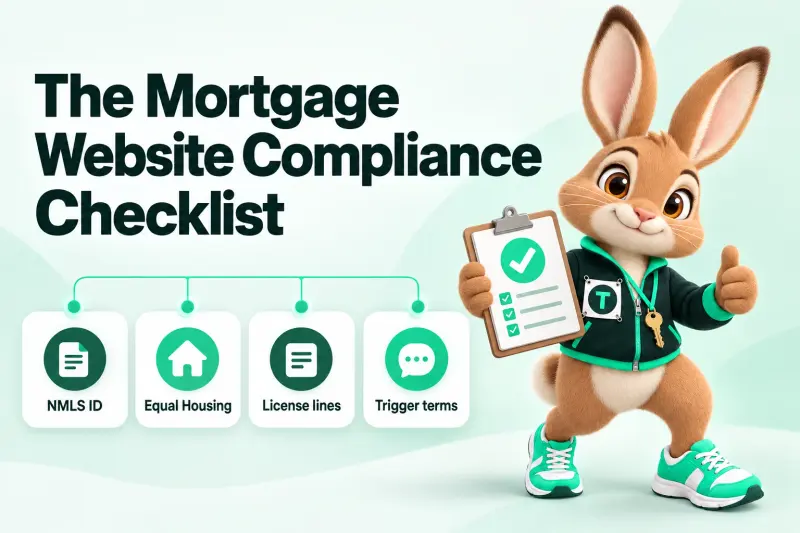
- Put compliance in first: your NMLS ID, your company's NMLS ID, licensed states and Equal Housing Opportunity on every page.
- Skip rates and payment examples until your compliance team approves the disclosures.
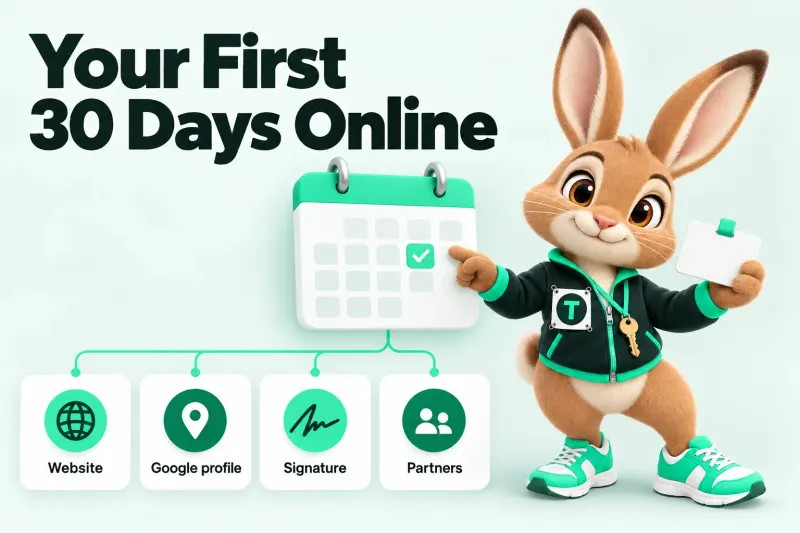
- Spend week one going live, week two being findable, week three on partners and week four on follow-up.
- Track real numbers from day one so you know what actually brings you conversations.
You passed the SAFE MLO test, your company sponsored you, and your NMLS record finally shows “approved”. Now the questions start: Where do I send people? What do I put in my email signature? What happens when an agent Googles me? This guide answers them in order. It’s the plan our launch desk uses with newly licensed loan officers, written so you can follow it whether you build the site yourself or have it built.
The short version: your first loan officer website has one job — turning “who is this?” into a conversation. Everything below serves that job.
Why does a new loan officer need a website at all?
Because the people who could send you business will look you up before they do. A real estate agent deciding whether to put your name in front of a client, a friend-of-a-friend buyer, a builder’s sales rep — all of them search your name. If they find nothing, or a bare company directory listing, you look like someone who might not be around in six months.
That matters more right now, not less. The pool of buyers is tight and competitive:
First-time buyers as a share of home purchases
Show data table
| Buyer type | Share of buyers |
|---|---|
| First-time buyers | 21% |
| Repeat buyers | 79% |
Fewer first-time buyers means every one of them is shopping carefully and checking who they’re dealing with. Rates are also well above the lows many buyers remember, which makes borrowers more anxious and more likely to research before they call:
30-year fixed mortgage rate, annual average
Show data table
| Year | 30-year fixed (annual average) |
|---|---|
| 2015 | 3.85% |
| 2016 | 3.65% |
| 2017 | 3.99% |
| 2018 | 4.54% |
| 2019 | 3.94% |
| 2020 | 3.11% |
| 2021 | 2.96% |
| 2022 | 5.34% |
| 2023 | 6.81% |
| 2024 | 6.72% |
| 2025 | 6.6% |
The industry itself is leaner, too. The BLS counts about 283,000 loan officer jobs in 2025 with employment projected to grow just 1% from 2025 to 2035 (BLS Occupational Outlook Handbook, retrieved 2026-10-19). In a slow-growth field, the LOs who look established early get the referrals.
What does your first loan officer website have to show?
Think of it in three blocks.
1. Who you are. A real, recent photo. A bio that sounds like you, not like a mission statement. Where you work, who you love helping, the languages you speak. “I help first-time buyers in Pinewood County figure out what they can afford, evenings included” beats “dedicated to excellence in home financing” every time.
2. That you’re licensed. Your individual NMLS ID, your company’s name and company NMLS ID, the states you’re licensed in, and Equal Housing Opportunity (or your company’s preferred Equal Housing Lender wording). Link the NMLS IDs to NMLS Consumer Access so anyone can verify you in one click. This isn’t decoration — it’s the trust signal agents and borrowers actually check.
3. How to start. Two clear next steps on every page: a short application and a way to book a call. Calculators help here because “what would my payment be?” is the question most borrowers arrive with.
The pages to launch with
| Page | What it does | Must include |
|---|---|---|
| Home | Says who you help and what to do next | Photo, one-line promise, apply + book buttons |
| About | Builds trust | Real bio, NMLS ID, licensed states |
| Loan programs | Matches search intent | Only programs you can originate, no rates |
| Calculators | Starts conversations | “Estimate only” disclaimer, neutral defaults |
| Apply | Captures the lead | Short form, consent language, privacy link |
| Contact | Removes friction | Phone, booking link, hours |
| Policies | Required basics | Privacy, terms, licensing disclosures |
That’s seven pages. Resist the urge to add twenty. A tight, finished site beats a sprawling one with “coming soon” pages.
What should you leave off (for now)?
Rates and payment examples. Under Regulation Z §1026.24, certain “trigger terms” in an ad — a down payment percentage, a number of payments, a payment amount or a finance charge — require additional disclosures (down payment, terms of repayment and the APR). As a new LO, the simplest compliant move is to talk about programs and process and let rates happen in the conversation. If your company provides an approved, dated rate feed with disclosures, that’s a separate discussion with your compliance team.
Superlatives. “Lowest rates”, “fastest closings”, “guaranteed approval”. They’re risky claims and they make you sound like everyone else.
Stock handshake photos. Borrowers have seen them a thousand times. A slightly imperfect photo of you does more.
Testimonials you don’t have. Never invent them. If you have none yet, say nothing — or show your process instead. The FTC’s rule on consumer reviews (16 CFR Part 465) bans fake reviews and testimonials outright.
The 30-day plan, week by week
Week 1: go live
The goal of week one is a finished, approved site with your name on the domain.
- Day 1: Gather your NMLS ID, company NMLS ID, licensed states, a headshot and a short bio. Ask your manager who approves marketing.
- Day 2–3: Build (or have built) the seven core pages.
- Day 4: Send the draft to your compliance or marketing team with a list of every disclosure and where it appears. Approvals move faster when nobody has to hunt.
- Day 5: Fix their comments, connect your domain, switch on SSL, and test the application form on your phone.
If you use a done-for-you service, this is exactly what a 5-business-day launch covers.
Week 2: be findable
- Update your email signature and every social bio with the link and your NMLS ID.
- Set up a Google Business Profile if your company allows it — many don’t allow LO-level profiles, so ask first.
- Ask five people who know your work (past colleagues, clients from a previous career, your sponsor) for an honest recommendation on a profile you own.
Week 3: partners
Make a list of twenty agents and builders you know or could reasonably meet. Send each a short, personal note with your link. Offer something useful — a first-time buyer checklist, a quick explanation of a program they ask about often — rather than asking for business outright.
A first-month referral partner outreach funnelIllustrative example
Show data table
| Stage | People |
|---|---|
| Agents and builders contacted | 20 |
| Replied | 8 |
| Coffee or call | 4 |
| Sent a first referral | 1 |
Your real numbers will differ. The point of the funnel is to remind you that a first referral usually comes from a handful of real conversations, not from a launch announcement.
Week 4: follow-up
- Put every lead and partner into one CRM. A spreadsheet is fine for week four; a real CRM with alerts is better by month two.
- Write a simple follow-up: an instant reply when someone fills in your form, a personal note the next day, a check-in on day three.
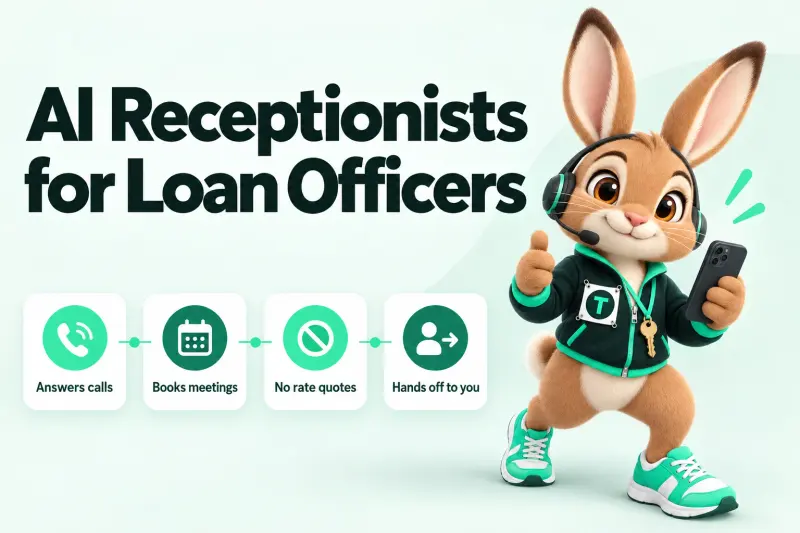
- Decide your next investment: loan-program funnels if you’ll run ads, blog content if you want long-term search traffic, or an AI receptionist if you’re missing calls while you’re with clients.
Company page, DIY builder or done-for-you?
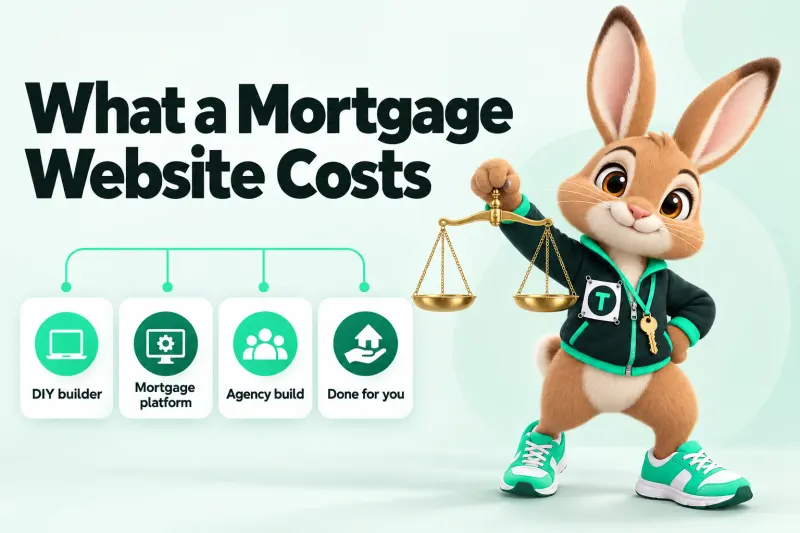
Three ways to get your first site
Company profile page
Free, fast, limited
- Compliance handled by your company
- No cost to you
- Usually stays behind if you switch
- Rarely ranks for your name
DIY builder
Cheap software, expensive time
- Low monthly cost
- Total control
- You write and check every disclosure
- Mortgage tools need add-ons
Done-for-you
Live in days, compliance-first
- Written, checked and launched for you
- Calculators and application included
- Monthly subscription
- Less pixel-level control
There’s no wrong answer. If you have evenings free and enjoy building, a DIY builder works — use the checklist as you go. If your time is worth more spent on calls with agents, done-for-you pays for itself quickly. Our First Desk plan is $79/mo; compare options fairly on our alternatives page.
Five mistakes newly licensed LOs make online
- Waiting for the first closing to launch. Agents check you before they refer.
- Using a personal social account as the business page. Keep business and personal separate, and put your NMLS ID on the business profile.
- Leaving the NMLS ID off. It belongs on your site, your ads and your social bios.
- Copying another LO’s bio. It reads as generic, and it isn’t you.
- No follow-up system. A lead that waits until tomorrow has often already called someone else.
What to measure in your first month
You don’t need a dashboard. You need three numbers, written down weekly:
| Measure | Why it matters | Where to find it |
|---|---|---|
| Conversations started | The real output of your site | CRM or a simple log |
| Source of each conversation | Tells you where to spend time | Ask “how did you find me?” every time |
| Time to first reply | Fast replies win more conversations | CRM timestamps |
After four weeks you’ll know whether partners, search, social or your sphere is working — and you’ll have a site that’s ready for whichever one it is.
How do you write a loan officer bio that people actually read?
Most loan officer bios read like a résumé. The ones that start conversations read like an introduction from a friend. Use this four-part structure and keep it under 200 words:
- Who you help, specifically. “I work mostly with first-time buyers and veterans in the Pinewood area.”
- Why you do it. One honest sentence — a personal story, a past career, the moment you decided to get licensed.
- How you work. “I explain every option in writing, I answer texts in the evening, and I’ll tell you if waiting six months is the smarter move.”
- What to do next. “Book 15 minutes or start a short application — no pressure either way.”
Then add the facts: your NMLS ID, your company and its NMLS ID, the states you’re licensed in and the languages you speak.
| Instead of… | Try… |
|---|---|
| “Committed to excellence in home financing” | “I help first-time buyers figure out what they can afford” |
| “Years of experience in the financial industry” | “Before mortgages I spent six years as a teacher — I like explaining things” |
| “Contact me today for the best rates!” | “Book a 15-minute call and we’ll look at your options” |
A new LO’s biggest advantage is time and attention. Say so. Borrowers who feel rushed elsewhere will notice.
Your first-30-days checklist
- NMLS ID, company NMLS ID, licensed states, Equal Housing on every page
- Real photo and a bio in your own words
- Seven core pages, no “coming soon”
- Compliance approval saved in your email
- Domain connected, SSL on, forms tested on a phone
- Signature and social bios updated with the link
- Twenty partner notes sent
- Every lead in one place, with a same-day reply
If you’d like the whole list done for you — site, compliance pass and launch — that’s what our launch timeline is built around.

Written by
Maren Holt, Launch Editor
Maren writes our launch guides: what a new or moving loan officer needs live on day one, and in what order.
Editorial persona — GetsMortgageNow launch desk · Writes from our build checklists and onboarding notes
Sources
- Freddie Mac Primary Mortgage Market Survey via FRED (MORTGAGE30US), annual averages — retrieved 2026-10-19
- NAR — 2025 Profile of Home Buyers and Sellers — Nov 4, 2025
- BLS Occupational Outlook Handbook — Loan Officers — retrieved 2026-10-19
- CFPB — Regulation Z §1026.24 (advertising)
- NMLS Consumer Access
Educational content, not legal, compliance or financial advice. GetsMortgageNow is not a lender.
 Mortgage advertising compliance for loan officers
 What a mortgage website costs (and what you get)
 AI receptionists for loan officers: what they can (and must not) say