Key takeaways
- SEO earns rankings, AEO earns the extracted answer, GEO earns citations in AI assistants — the same well-built page serves all three.
- Speed is the floor: Google's Largest Contentful Paint is 'good' at 2.5 seconds or less.
- One keyword per page, answer-first structure and page-specific FAQs do most of the work.
- Structured data, an llms.txt file, consistent names and sourced facts make you easier to cite.
- Nobody can guarantee rankings or AI mentions; anyone who does is guessing.
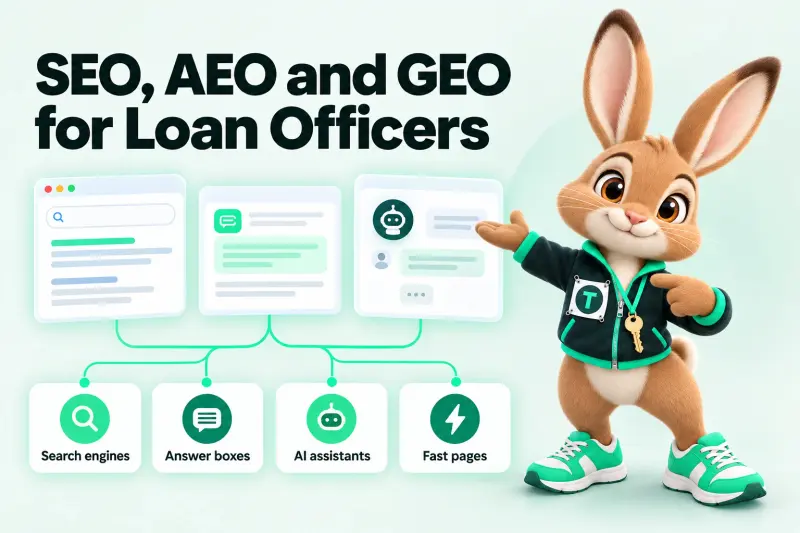
Three acronyms now get thrown at loan officers: SEO, AEO and GEO. They sound like three separate projects with three separate invoices. They aren’t. They’re three ways the same well-built page gets found — in a list of results, as the answer at the top, or as a source inside an AI assistant’s reply.
What do SEO, AEO and GEO actually mean?
Three ways to be found
SEO
Rank in search results
- One keyword per page
- Crawlable, fast, linked
- Takes time on competitive terms
AEO
Be the extracted answer
- Question headings
- Answer in the first two sentences
- Answer boxes are chosen automatically
GEO
Be cited by AI assistants
- Sourced facts, consistent names
- llms.txt and schema
- No one controls AI outputs
What all three reward is the same: pages that load quickly, say clearly what they’re about, answer the question directly and prove their claims.
Speed is the floor, not the ceiling
A slow page hurts all three. Google measures real-user experience with Core Web Vitals, and its documentation defines what “good” means:
Google’s Largest Contentful Paint bands (seconds)
Show data table
| Metric | Good (0–2.5 s) | Needs improvement (2.5–4 s) | Poor (beyond 4 s, shown to 6 s) |
|---|---|---|---|
| LCP | 2.5 s | 1.5 s | 2 s |
The other two “good” thresholds are an Interaction to Next Paint of 200 milliseconds or less and a Cumulative Layout Shift of 0.1 or less (web.dev). For a loan officer site, the usual culprits are heavy page builders, sliders, chat widgets and tracking scripts that load before the content. We build every page to score 90+ on PageSpeed Insights — and you can check any site yourself.
SEO: the parts that matter for a loan officer
One keyword per page
Make a simple map: each page owns one search. Your home page might own “loan officer in [city]”; your bio page owns “[your name] loan officer”; each program page owns “[program] loans [state]”. When two pages chase the same phrase, both usually lose.
| Page | Owns this search | Avoid |
|---|---|---|
| Home | loan officer in [city] | Generic “mortgage” headings |
| About | [your name] loan officer | A bio with no name in the heading |
| FHA page | FHA loans [state] | Rates and payment examples |
| First-time buyers | first-time home buyer [city] | Copy that could be anywhere |
| Calculators | mortgage calculator [state] | Calculators with no explanation |
Titles, descriptions and headings
A unique title under 60 characters, a description under 155 characters written to earn the click, one H1, and question-shaped H2s. Boring, and it works.
Local signals
Consistent name, phone and service area everywhere; a Google Business Profile if your company allows one; and local content only where it’s genuinely local.
Technical hygiene
An XML sitemap, a sensible robots.txt, canonical URLs, breadcrumbs, no broken links. These don’t win rankings on their own; they stop you losing them.
AEO: write so the answer can be lifted
Answer engines look for a direct answer immediately under a question. That changes how you write, not what you know:
- Question-shaped heading: “How is debt-to-income calculated?”
- Answer in the first two sentences: “Your DTI is your monthly debt payments divided by your gross monthly income.”
- Then the detail: examples, exceptions, a table.
- Then the source: a named, dated reference.
Add a short definition block for key terms, use numbered lists for steps and tables for comparisons, and give every important page its own FAQ — not one FAQ repeated sitewide.
GEO: make yourself easy to cite
AI assistants combine information from many sources. You can’t control what they say, but you can be an easy, trustworthy source:
- Crawlable content. Plain HTML, not text hidden behind scripts; AI crawlers allowed in robots.txt.
- An llms.txt file. A plain-text summary of who you are and your key pages.
- Consistent entity names. Your name, company and NMLS ID written the same way on every page and profile.
- Facts with sources. “According to [source], [date]” in the same sentence as the number.
- Structured data. Organization, Person, Service, FAQPage and BreadcrumbList connected in one graph.
What about “AI SEO” services promising mentions?
Be skeptical of anyone promising that an AI assistant will recommend you. The work that helps is the same as above; the outcomes depend on systems nobody outside those companies controls.
A practical checklist
- Every page has one primary keyword and a unique title and description
- H1 contains the keyword; H2s are real questions
- The first 100 words answer what the page is about
- Page-specific FAQs on every important page
- Statistics carry a named source and date
- Organization, Person, Service, FAQPage and BreadcrumbList schema, generated from one data source
- XML sitemap index and robots.txt with deliberate AI-crawler choices
- /llms.txt published and current
- Largest Contentful Paint under 2.5 seconds on mobile
- Name, company and NMLS ID identical everywhere
A worked example: rewriting an FHA program page
Here’s how a typical loan officer FHA page changes when it’s rebuilt for search, answers and AI citation.
| Element | Before | After |
|---|---|---|
| Title tag | “FHA Loans” | “FHA Loans in Texas | Jordan Example, NMLS ID ######” |
| H1 | “Our FHA Program” | “FHA loans in Texas, explained in plain words” |
| First paragraph | Company history | “An FHA loan is a mortgage insured by the Federal Housing Administration. It often suits first-time buyers and people rebuilding credit.” |
| Headings | “Benefits”, “Apply” | “Who is an FHA loan for?”, “How does FHA mortgage insurance work?” |
| Numbers | “Just 3.5% down!” | Program described generally, linked to HUD; numbers only with approved disclosures |
| FAQ | None | 8–12 page-specific questions |
| Next step | “Contact us” | Calculator plus “book 15 minutes” |
| Schema | None | Service, FAQPage, BreadcrumbList, linked to the Person and Organization |
None of these changes are tricks. They make the page clearer for a borrower, which is exactly what ranking systems and answer engines are trying to reward.
A first-90-days content plan
You don’t need fifty articles. You need the right dozen, in order:
| Month | Focus | Example topics |
|---|---|---|
| 1 | Your core questions | “How much do I need for a down payment?”, “What documents do I need?” |
| 2 | Your programs | “FHA vs conventional for first-time buyers”, “How VA entitlement works” |
| 3 | Your area | Genuinely local guides: buying in your county, local first-time buyer programs (with official links) |
Write each one answer-first, give it its own FAQ, link it to the matching program page, and update it when the facts change.
Internal links: the overlooked lever
Every page should link to the pages a reader needs next, with descriptive anchor text — “how FHA mortgage insurance works”, not “click here”. Program pages link to the calculator and the application; articles link to the program they explain; the home page links to the programs you most want to be known for. This helps readers, and it helps search engines understand which pages matter most.
Common SEO mistakes on loan officer sites
- Every page titled with the company name only. Search engines can’t tell the pages apart.
- No individual name on the page. Borrowers search for you.
- Duplicated program pages across many LOs. Identical text on hundreds of sites helps none of them.
- City pages with only the city name changed.
- Stale rate content. It’s a compliance problem and a quality signal problem.
- Slow, script-heavy pages that fail Core Web Vitals on mobile.
- A blocked or messy robots.txt that hides the site from the crawlers you want.
How to measure it
| Signal | Tool | What good looks like |
|---|---|---|
| Rankings and clicks | Google Search Console | Your name and program pages gaining impressions |
| Speed | PageSpeed Insights | Green Core Web Vitals on mobile |
| Answer extraction | Search your own questions | Your sentence quoted in answer features |
| AI citations | Ask assistants your borrowers’ questions | Your pages appearing as sources |
| Leads | Your CRM | Conversations tagged by source |
SEO, AEO and GEO aren’t three projects. They’re one discipline: build a fast, honest, well-structured page that answers a real question better than anyone else nearby.

Written by
Dev Okafor, Search & Speed Editor
Dev covers site speed, schema, SEO, answer engines and AI search for mortgage websites.
Editorial persona — GetsMortgageNow build team · Writes from our build and schema specs
Sources
- web.dev — Largest Contentful Paint
- web.dev — Interaction to Next Paint
- web.dev — Cumulative Layout Shift
- Google Search Central — Introduction to structured data
- Google Search Central — Creating helpful, reliable, people-first content
- llms.txt proposal
Educational content, not legal, compliance or financial advice. GetsMortgageNow is not a lender.
 What a mortgage website costs (and what you get)
 Your first loan officer website: a 30-day plan
 AI chat on social and SMS for loan officers